
Ink-tastic and Fantastic 🐙

So today's blog is going to be about octopus, the most intelligent invertebrates in the ocean. I'll do some quick facts, as well as some info about how smart these guys are, and go over some ways to tell octopus apart from squid. There's so much I'd like to cover about them, but I don't want to write hundreds of paragraphs, and it would be super easy to with these guys. They have complex nervous systems, advanced camouflage abilities, and remarkable problem-solving skills, they challenge everything we think we know about animal intelligence and are very interesting little guys to be around or research.
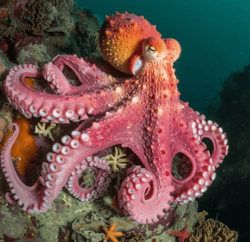
Let's do a few fun facts about these guys first:
-
An octopus has three hearts. Two pump blood to the gills, and one pumps it to the rest of the body.
Fun fact: the heart that pumps to the body actually stops beating when they swim, which is why they prefer crawling. - Octopus blood is blue because it contains hemocyanin, a copper based molecule that helps transport oxygen in cold, low oxygen ocean environments.
-
About two-thirds of an octopus’s neurons are in its arms, not its brain.
Each arm can taste, touch, and even move semi-independently so it’s almost like they have eight tiny brains. -
Some species, like the Mimic Octopus, can impersonate other sea animals such as lionfish, flatfish, and sea snakes.
They can change color, texture, and even body shape in seconds. - Octopuses can open jars, navigate mazes, and remember solutions. They’re considered among the most intelligent invertebrates on Earth.
- Because they have no bones, an octopus can squeeze through any hole larger than its beak, which is about the size of a coin in many species.
- Each suction cup can taste what it touches. That's the equivalent to if you could taste with your fingertips.
_________________________________________________________________________________________________________________________________________________________________________________________________________________
Octopus vs. Squid: Knowing the difference.
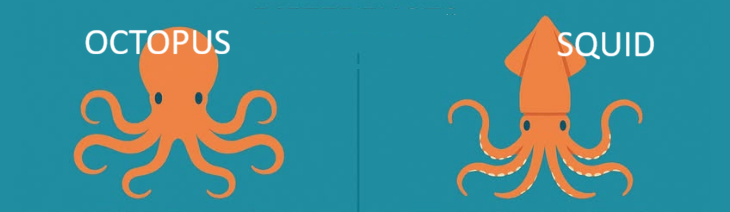
Octopus:
Has a round, soft body.
Mostly found on the sea floor.
An Octopus has a rounded shaped head.
Octopus have eyes on the top of their heads.
They are solitary creatures and do not live in groups. They can be seen with babies sometimes, as they care for their young.
An Octopus only has 8 arms, and does not have tentacles like the squid does.
Squids:
They have a very triangular shaped head and their bodies are long as opposed to the Octopus, which is more round.
Squids have 8 arms and 2 tentacles.
Their eyes are on the sides of their heads.
Squids have been known to live in groups and can often be found with other squid.
They are usually found in the open ocean and not on the sea floor like an octopus.
_________________________________________________________________________________________________________________________________________________________________________________________________________________
The smartest animal of the ocean?
Octopuses are considered the most intelligent invertebrates on Earth, with complex nervous systems and around 500 million neurons distributed throughout their bodies. Unlike most animals, a large portion of their neurons are located in their arms, allowing them to process information and move semi-independently. This unique setup contributes to their impressive problem-solving abilities. In laboratory settings, octopuses have been observed opening screwtop jars to reach food, navigating mazes, recognizing individual humans, and even escaping from secure tanks. They are capable of learning through observation and remembering solutions to tasks long after first encountering them. Their intelligence makes the octopus one of the most remarkable thinkers in the ocean.
When faced with a new obstacle, an octopus will explore it with careful, deliberate movements, testing and adjusting until it finds a solution. Studies have shown they can distinguish between shapes and patterns, remember successful strategies, and adapt when circumstances of their environment change. Their ability to rapidly camouflage by processing visual information and altering their skin in real time also reflects advanced neural control. Rather than reacting automatically, octopuses demonstrate curiosity, memory, and problem-solving skills that suggest a highly developed and independently evolved form of intelligence.
_________________________________________________________________________________________________________________________________________________________________________________________________________________
Hope you guys enjoyed reading this, and walked away with a little more info about octopus!~

Edited by Sakura
-
 3
3
-
 1
1
-
 1
1
-
 1
1
-
 2
2
-
 2
2
22 Comments
Recommended Comments