Orius
-
Posts
852 -
Joined
-
Last visited
-
Days Won
6
Content Type
Profiles
Forums
Blogs
Everything posted by Orius
-
Oh yeah, I heard that movie was good.
-
Looks interesting. I'll be sure to check it out some time. lol
-

Who is your favorite Madoka Magica character?
Orius replied to SanguineTear's topic in Anime Discussion
I'm glad she got redeemed in the third movie though. It was great what they did with Sayaka, and I don't really mind the movie 3 ending anymore as I did back then (used to think that Homura-brainwashing scene looked quite painful for Sayaka). And yep, if you couldn't guess, my favorite's Sayaka. I think it wasn't so much that she's a great character that made me like her (I mean, don't get me wrong, I still think she's a great character), but rather, I connected with her quite well. Her insecurities reflected mine. Her desire to do good... I'm sure many of us have gone through the same notion at one time or another. The tale of good intentions gone bad through foolish actions is an old adage that will last for all time, forever repeated by men. I think it was kinda cruel to expect the best of actions to come from a 15 year old girl, so I think, for a girl like her, she held out pretty well in the end. Also MadoSaya ftw. Too bad I couldn't find the space-hug picture where Godoka was hugging Sayaka...
-
BABY! I compare you to a kiss from a rose on the gray. Ooh, the more I get of you, the stranger it feels, yeah! MAH POWER MAH PLEASURE MAH PAIN! http://www.youtube.com/watch?v=ateQQc-AgEM
-
For a show that relies heavily on understanding its dialogues (Psycho-Pass), allowing Commies to sub it was a pretty stupid-ass idea.
-
Shame that Durarara!!x2 is claimed not to be as good as the first season. I always felt that the anime was much... 'lighter' than the novel.
-
Danshi Koukousei no Nichijou turns out to be a 'hit or miss' comedy. Many jokes fell flat, especially compared to the actual "Nichijou".
-
Danshi Koukousei no Nichijou is freaking hilarious. My remedy for a lack of Gintama has arrived.
-
Just finished Mushishi Zoku Shou Part 2. Not bad. Still think the first season is somewhat better though. 8/10 Going to watch Cat Sh*t One and Danshi Koukousei no Nichijou next.
-
I dislike math for the most part, but only a Sith deals in absolutes.
-
As the thread title states, what's your favorite movie of all time? Mine would be Toy Story 2. It has everything I love about movies; emotions, drama, characters, a good story, and philosophy all mixed into one.
-
Uh, only one category? I was kinda interested in creating a club for non-anime movies... is that allowed? :'(
-
http://www.youtube.com/watch?v=NdpP6ynPbiY Love this so much more than the original theme.
-
The dry season, when your money is running low and good food is running out. This season should last shorter than the previous one though.
-
Updated my signature. My list of favorite anime is featured on my MAL profile : http://myanimelist.net/profile/Paul-Phoenix
-
I WANT MUSHISHI MOVIE, NOW! God, it's so unfair not to see it in theaters in Singapore when they have Dragonballs' latest movie screening.
-
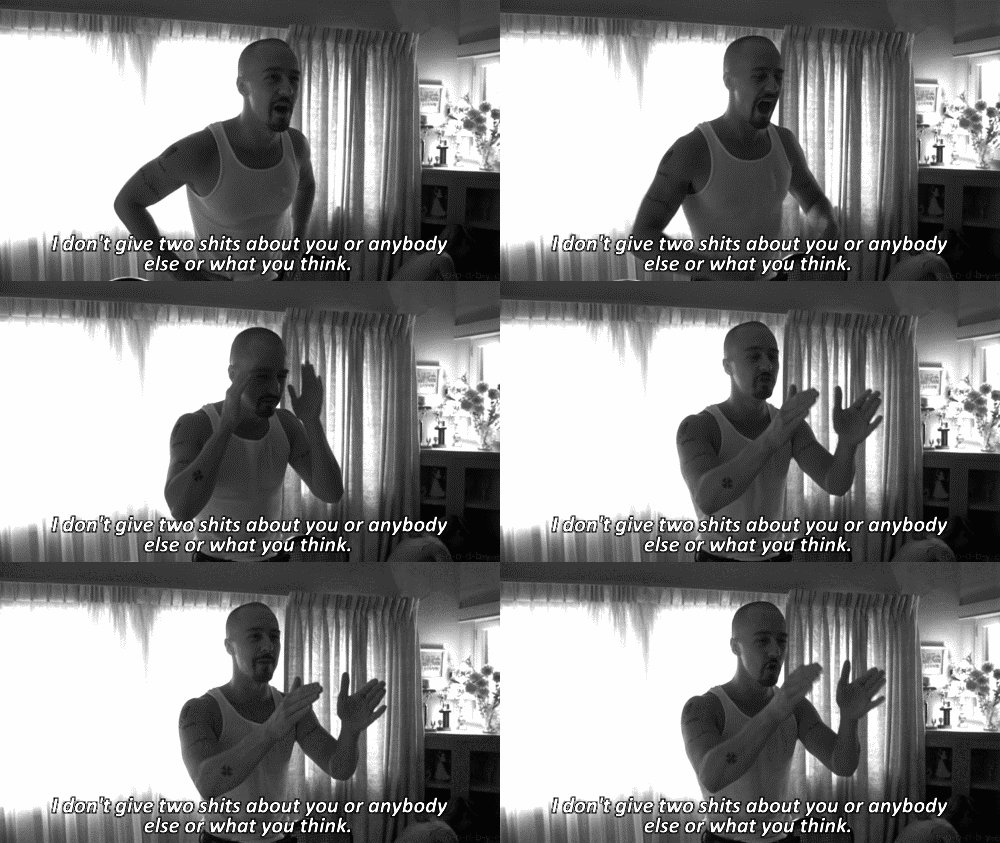
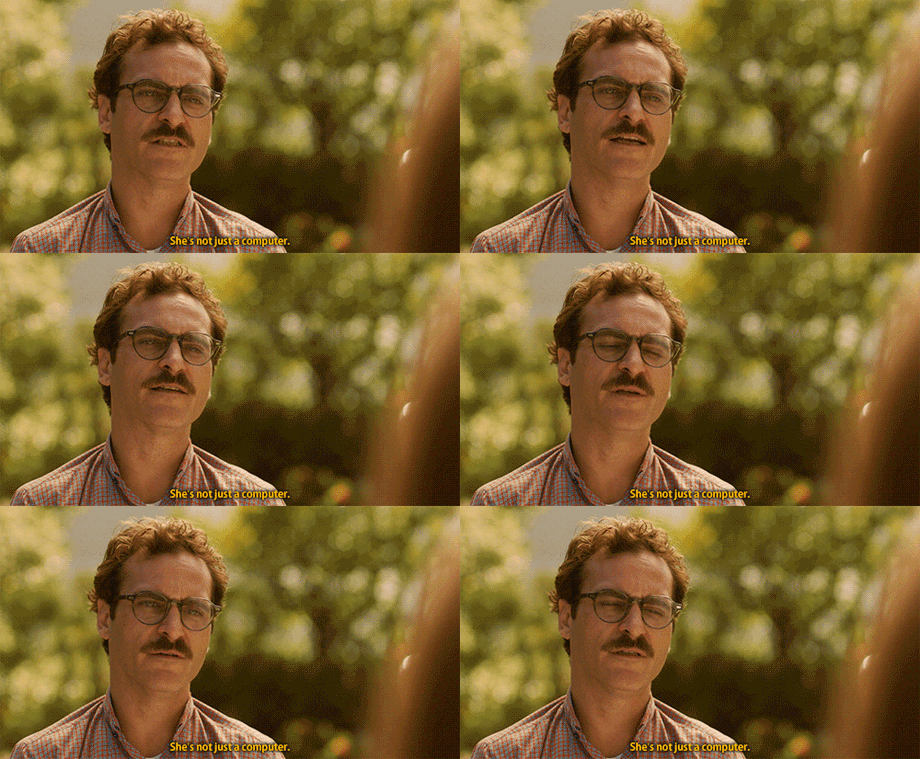
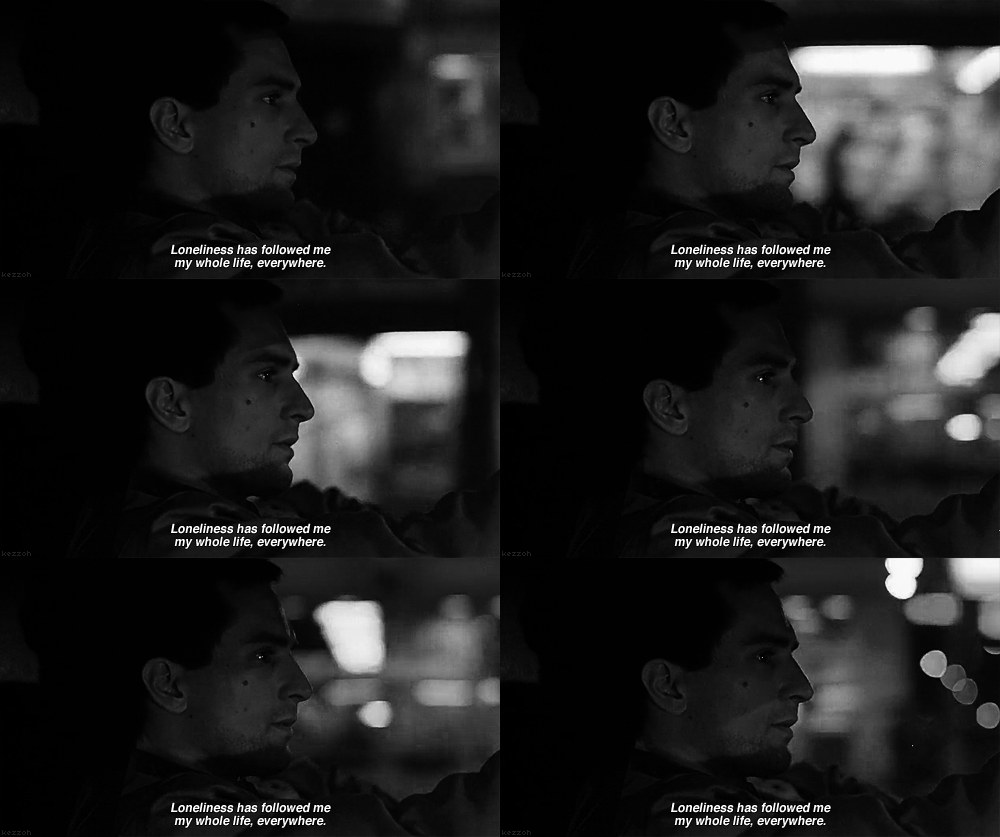
American History X And I kept asking myself all the time, how did I buy into this shit? It was because I was pissed off, and nothing I ever did ever took that feeling away. I killed two guys, Danny, I killed them. And it didn't make me feel any different. It just got me more lost and I'm tired of being pissed off, Danny. I'm just tired of it. There was a time when what Danny said to his stepfather, Murray, about 'liberal nonsense' that would resonate with my own feelings. That time wasn't too long ago. The line between oppression and hatred can often be confused in the defense of our insecurities. To me, American History X wasn't just about racism or even neo-Nazism; its topic is a much deeper problem that will never be solved - our capacity for hatred. It's an understatement to claim that the film drives its point with force. The picture is crystal clear and often verbose, but the message is all the same compelling. While I don't appreciate the 'telling' over 'showing', something writer David McKenna could learn the balance of from Fincher's wordy Fight Club, many of what was said reflected the feelings of many people I've met in real life. That said, it's hard to judge the film on its own merit without biasness, for this film felt like a counselling session to me more than it felt like a film. What's compelling to myself is still heavy-handed and lacks any subtlety. Instead of leaving the audiences to ponder on the terrible things that have occurred in the film, the ending is a punchline with the impact of an anvil. For a film featuring neo-Nazis, it's terribly ironic that such cinematic manipulation of the fascist kind was used. Naturally, Edward Norton's acting here is spectacular... until the final act. The thing about crying scenes, it can be difficult to make it believable. His 'emotions' here felt as artificial as those of Mike Shiner's on-stage, his other character in Birdman. Coincidentally, Norton would go on to star in another message-movie that was handled with much more subtlety and brilliance. But this isn't a David Fincher movie, so what do you expect? 6/10 Spring Breakers Spring Breakers is a movie you'd be wondering what someone like me would be watching. While I do go for fun movies, drugs, sex, and debauchery are kinda beneath me. Naturally, I watched this one with very little attention paid. I might as well have been high watching this. And yes, it does turn out to be more than just another tween movie about sex and drugs. Its commentary on the scandalous life of teenagers is still dumb though. I mean, teenagers can be dumb, but these kids in the movie make real teens look like Einsteins. James Franco gave a fantastic performance though, and Selena Gomez was actually pretty good too, much to my surprise. I don't know. Let's call it 6.5/10, guys. Meh. Her or (The Overrated Nature of Real Emotions) But it does make me very sad that you can't handle real emotions, Theodore There was a documentary on the population-decline crisis in Japan I saw some months ago. In it, two adult grown men were shown having a relationship with virtual girlfriends. They interacted with her bearing no shame nor irony, and one of them was even hesitant about choosing between the wife he was married to and the artificial girlfriend. On a more personal note, I related a lot more with fictional characters than with real people. Some of the best moments in my life were not spent with real people, offline or otherwise. Those moments instead belonged to movie characters. And yet, I laughed and cried all the same, artificial or not. Instead of my uneducated parents, it was movies (and TV shows) that helped shape the man I am today. And I certainly didn't turn out like The Cable Guy. And it is with that mentality that I related with the characters in Her. By the logic of Schrödinger's cat, are human emotions not real when you are unaware the methods through which your emotions are triggered? Theodore enjoyed the company of another individual - that enjoyment was real. Samantha's imitations of human behavior were also as real as our imitations of our parents' behavior. I learned more about human compassion from Toy Story 2 than from my own mother - was that fake? Could human emotions truly be imitated, patented, packaged, and ultimately be slapped into an operating system? If so, would it necessarily be such a bad thing? As pretentious as this might sound, the best thing about great art like this is that there isn't a definite answer provided. If the volatile nature of people is never definite, why should the imitation of people be anything but? And unlike American History X, Spike Jonze's Her doesn't preach nor lecture. It asks the whys but never answers. It connects with the audience through characters that we could care about (likable ones or otherwise), and it rarely bored us with any social agenda-shoving. And because we care and love the movie experience we have been put through, only then will any underlying message stick with us for lifetimes to come. Like most movies, naturally, this one has flaws. One romance sequence between Theodore and Samantha felt like it overstayed its welcome. I'm not sure as to which specific scene it was, but I believe it's the one right before Theodore proceeded to sign the divorce papers. Hence 'rarely bored', not 'never'. Joaquin Phoenix played an adorable, boyish character whose innocence bears the same believability and realism as the other performances (including Amy Adams looking like a normal woman, unlike in Man of Steel). Scarlett Johansson would be better off playing emotional characters like Samantha from now on, because I never bought her as a ruthless assassin named Natasha (aside from her one exception in The Winter Soldier). Oh, and Spike Jonze has landed as one of the filmmakers I'll be paying close attention to, alongside Fincher and Nolan. 8.8/10 Taxi Driver "The days go on and on... they don't end." Taxi Driver is one of those movies that you've heard many people hailed as a masterpiece, like Citizen Kane and Casablanca. Unlike my experience from the latter two, I shared these people's sentiment for the first time. Taxi Driver is a masterpiece. Unfortunately, some of the younger viewers seeing this for the first time in 2015 might dismiss Travis Bickle as a mere sociopath vigilante as they quote the one line, "Are you talkin' to me?" without remembering the more important second part, "Well, I'm the only one here." Truth be told, Travis crept me out at first, especially when he took a girl whom he had stalked to a porn movie. But halfway along the film, when Travis began working out, feeling like he had to do something to 'clean up this city', I remembered a short period of spiritual self-reexamination I had almost a year ago after watching Fight Club. Thinking back on the way he imitates how real people behave, the things he felt to be normal in the eyes of society, I found myself pleasantly surprised at relating to the character. The confusion one faces in his desperate grasp for relevancy isn't alien to many, especially those facing mid-life crisis. Trying to get in touch with a world he no longer has a place in, the 'Nam vet tries to reconnect with society in awfully awkward ways an ordinary person might determine (as I had) as "creepy", a label amongst many that people threw around a lot without stepping into the shoes of the creep and perceive the wretched world he sees. For a moment there, through the eyes of Travis, I had thought this was going to be another movie that touch on the topic of racism, but thankfully, Scorsese believed this would give the film an overly racist subtext and decided to change some of the negative black roles to white ones, preventing us from being distracted from the story that's Travis himself. Scorsese also almost shot this film in black and white much like Raging Bull, which I believe would have made the film a little less relatable, even as it forces the point that Travis' perspective is skewed. It is through such fine-tuning that Martin was able to connect us fully with Travis' inner thoughts; the mild racist undertones and the bright colored lights of the city painted both a believable and lonely perspective one that we've all shared at one point. An interesting scene to note, a scene that I still couldn't put my finger on the meaning of it, is the assassination of Palantine, which could be interpreted in numerous ways, one of which involved screenwriter Paul Schrader describing the scene as relating to "sexuality", or rather, a sexual rivalry. I believe it's a culmination of many elements, and not just the threat of Palantine's sexuality. Trevor didn't just want to stay relevant; he was a nobody who wanted to be somebody. He wanted to be famous. And in what was presumed by many to be a delusion (myself included), Trevor did become a famous hero despite killing people and getting scot-free. But I think it speaks much more in length if it's not just a delusion (Trevor's neck-scar is proof enough anyway), as it bears parallels to modern day cinema when something becomes famous for the wrong reasons, much like many Hollywood movies today. Much like the pop(pular) culture today, actually, where we hold up a lonely man as a badass vigilante. 10/10 In Closing I know I don't talk a lot about the actors or the camera works in my reviews. Admittedly, I'm not very knowledgeable when it comes to these things. Both Robert De Niro and Jodie Foster are splendid artists - that point you wouldn't need any convincing, much less from me. The one I really want to talk about is Jodie Foster, whom I've always admired as an actress. Some would claim that having a young actress pose as a prostitute was crude and even "disgusting", but I think it was crucial to the picture Martin was trying to paint. A dispassionate attitude towards such casting is utmost necessary, and I think Jodie truly deserved the role. Unlike some other viewers, I don't see it as drawing allure to a twelve year old. It's but a cruel aspect of a cruel world, and one shouldn't have to be dishonest about it. And of course, the cinematography is undoubtedly brilliant. The way the city (and the city-folks) feels so detached from Trevor's character works effectively in furthering the isolation we felt. It's a metaphor given vibrant life, and it couldn't be more bittersweet. Even at the end of it, Trevor sent little Betsy home without advancing onto her, without any of the smooth-talking we have seen before. Even after gaining fame and romance, there's a sense of loneliness that still lingers so in this city of bright lights. Mission: Impossible My face throughout many moments of this film. Whenever I talked about this film, I tend to throw around the word, "memorable" too often. While a film doesn't necessarily need to be memorable to be good, for myself - more often than not - a fun film is a memorable one. I would just as soon try and forget the film if it's terrible. So yes, for what is probably the first time in a long time, this review is based on my own personal enjoyment, and not so much an 'objective' one. Time to travel down the sweet ol' memory lane of nostalgia. There were quite a number of times that Ethan Hunt has been hailed as "The American James Bond". While I could certainly see how they arrived at that conclusion, I feel that he doesn't have the suave and style of James Bond to be James Bond. Instead, he's a nice mix between Jason Bourne's hyper-intelligence and James Bond's masculinity. A number of scenes in this movie either showed Ethan's intellectual prowess or attempt to convince the audience of his competence as an agent through exposition done by other characters, like Kittridge telling us that Ethan's not shortsighted. "This guy initiates. He's proactive." Half of these attempts are unrealistic and even over-the-top at times, especially when I'm watching this at 25. But you know, I didn't really care. Many things in this movie are hyperbole - and it is so much fun. Brian De Palma directed this to be a style over substance movie, and it works spectacularly. I've talked a lot about the first movie's thriller element, and it's thanks to this style in the movie that made it such a cool spy film for me back then. Today, I still enjoy this style a lot, especially when it's applied to the most memorable scene of this movie - the cable drop scene. It's so iconic it even got its own TV Tropes page. The funny thing about the cable-drop scene was that, unlike other death-defying stunts people would usually find more memorable, this was a seemingly much easier scene to film. Yet, I think it's the way the scene was presented that made it as iconic as it is. A crucial part of this scene was the five minutes of silence, the lack of background score. The suspense was very well done here thanks to that, and if there was any music like many movies today, I think we wouldn't have been as on edge as Ethan was. For myself, the explanation of the plan itself before it happened had already built up my curiosity to the brim. When I was a kid, I thought this plan of theirs was so clever, complex, and just cool. The security was tightened with lasers, sound-detectors, thumbprint-scanner, retinal-scanner, pressure-detector, and a temperature-detector. Explain that to a little kid like me back then and my mind was blown. And I think the best part of this compared to something like the diving scene in the opening of Goldeneye was how much fun this scene was for children to reenact (I remember playing out the entire scene, from the hanging to Krieger accidentally loosening the rope to the sweat-catching). The part where Ethan catches the sweat dripping from his glasses is one of the ridiculous hyperbole that I've mentioned, but I think the exaggeration merely made this scene all the more better. Speaking of hyperbole, there were two other scenes in this movie that stuck in my mind. First off, the aquarium scene about the mole hunt. It's not just the explosion of the fish tank. Everything cool about this entire movie and all its scenes is about presentation, and the way the scene was presented right before Ethan threw the gum-explosive at the tank was, in lack of a better word, epic. Danny Elfman's heart-pounding track, "Mole Hunt", accompanied this scene very well, till the breaking point where the orgasmic climax come to an explosion: Eugene Kittridge: "I understand you're very upset." Ethan Hunt: "Kittridge, you've never seen me very upset." Eugene Kittridge: "All right, Hunt. Enough is enough. You have bribed, cajoled, and killed, and you have done it using loyalties on the inside. You want to shake hands with the devil, that's fine with me. I just want to make sure that you do it in hell!" (*Ethan swipes a glass at Kittridge's face as he tosses the gum, running out the restaurant with badass style*) http://www.youtube.com/watch?v=KOi9hHjmYq4 Oh, I came. Such a great speech from Kittridge. Like they say, "It's not about what you say, it's how cool you look saying it." And Henry Czerny really delivered. The second scene is the helicopter scene, though it didn't stick with me as well as the above one. Still a very fun scene to reenact in my bedroom though. Krieger's blade is closing in on Ethan as Danny Elfman once again orchestrated the scene with style (this time an action-packed track titled ). Krieger misses by a hair's length because deus ex machina saved Ethan just in time. The helicopter comes in again, the hero jumps onto it, the movie theme begins to play once again to get the audience excited and Ethan goes, "RED LIGHT! GREEN LIGHT!" BOOM! Explosion, with the blade spinning, spinning, nearly slicing his throat at the end. http://www.youtube.com/watch?v=Cho039BrHpg Oh yes! YES! Phew. Ahem. Sorry'bout that. Needless to say, this film has a lot of style. The part where Ethan pieces together in his head how their first mission at the beginning went wrong was another of my favorite scene. As Ethan recollects how the scene really went down, Danny Elfman haunts us with the beautiful track, "Betrayal". All the pain and anger Ethan felt as he thinks about the man he trusted the most backstabbing his team, the score reflected it well. Next to Batman, this is Elfman's most amazing score yet. "Why, Jim? Why?" "When you think about it, Ethan, it was inevitable. No more Cold War. No more secrets you keep from everyone but yourself. Operations, you answer to no one but yourself. And then one day, you wake up, the President of the United States is running the country without your permission. The son of a bitch, how dare he? Then you realize, it's over. You are an obsolete piece of hardware not worth upgrading. You've got a lousy marriage, and 62 grand a year.” As another review praising the film said, "The story fits the post-Cold War era of the '90s. The Cold War was over and terrorism wasn't Hollywood's new boogeyman, yet." Now we can get to the final part of the review covering another good thing about the movie - the acting. Thanks for having the patience for reading so far if you haven't skimmed it. ;D Tom Cruise. Oh, Tom Cruise. You know, several years ago, before I discovered A Few Good Men, I wouldn't have thought of him as a good actor. Back then, I merely knew him from action movies, and he was about as good an actor as Chris Pratt - you know how I feel about Chris. Then came along this young fellow in the aforementioned movie and I began to pay a lot more attention to his past roles. If anything, when he was first cast in Mission, the opposite expectation was true at the time; people didn't think he's not a good actor, people thought he's not a good action star. He wasn't your typically muscular guy with a gruff exterior; if anything, he was a pretty boy. But boy, did he come round to change their mind, kinda like when Daniel Craig got off Layer Cake. Gone were the days of Arnold, and in with the days of Keanu Reeves and Tom Cruise. Jon Voight as Jim Phelps is naturally one of my favorite characters of this film, just a little bit more than Henry Czerny as Eugene Kittridge. Jon brought a kind of weight and charisma that I almost questioned why Phelps betrayed the team as Ethan did during the "piecing together" scene. Henry's portrayal of Kittridge has been overstated by myself plenty of times, but with what little screentime he had, it was fun to watch him squeeze Ethan. Laurence Fishburne, who would come to play a similar role in M:I:III, didn't leave such impression. There's also Ving Rhames as Luther Stickell (whom I've already expressed displeasure at his returning appearances in the M:I thread) and Jean Reno as Franz Krieger. Krieger, while not as intriguing as Kittridge, still bears the kind of charm only Jean Reno could bring into a movie. Unfortunately, Kristin Scott Thomas as Sarah Davies was, IMO, the worst main character of the movie. Her damsel in distress persona didn't bring anything memorable or interesting to the cast, and even Stickell was a lot more fun to watch than Kristin's one-note acting here. And that concludes the lengthy review. I had a lot of fun writing this, and I hope you had as much fun reading it... despite the few cringe-worthy moments (ahem). 9/10 Yep. V For Vendetta He was you... and me. He was all of us. Released on: March 17, 2006 Directed By: James McTeigue Written By: Andy and Lana Wachowski Starring: Natalie Portman as Evey Hammond Hugo Weaving as V Stephen Rea as Eric Finch John Hurt as High Chancellor Adam Sutler There were two comic book adaptations of which their source material I wasn't familiar with, and yet I still enjoyed the heck out of these two films. One of them was Watchmen, the other was V. Coincidentally, both of them were written by Alan Moore. But as V would say, there are no coincidences, only the illusion there of. I would later come to enjoy the Watchmen graphic novel very much, but unfortunately, V For Vendetta's literary counterpart was too verbose for me to even enjoy the first page (likewise with Moore's other work, From Hell). And V is indeed a verbose film, but unlike others, it's done intentionally with style. That's perhaps the best compliment I could offer this movie, that it has a lot of style, credits probably due to the Wachowskis. The reason I brought up Alan Moore is because half of the two films' success is due to the well-written source material, especially Watchmen. Just look at Zack Snyder's attempt at Man of Steel, which wasn't based on a single work but several. Now, the other half is, naturally, just as important, for a comic book adaptation, like From Hell, could easily fall flat as well without the right direction. The problem is, several years afters my first (few) viewing of V For Vendetta, the nostalgia has worn off and all its flaws begun to surface. There's a reason why V For Vendetta was considered a lesser movie than Watchmen by many, in spite of their disdain towards the latter. I think the biggest problem with the movie was its style. Much like many Hollywood blockbusters, the flash and bang lessened the material. Getting the writers of The Matrix creators probably wasn't the best idea either, as I considered that franchise more style over substance. James McTeigue would later be responsible for the much more mediocre Ninja Assassin and his true skill as a director would finally appear without the aid of the Wachowskis or Alan Moore's fine work. An important quote from the Wikipedia article, "Furthermore, in the original story, Moore attempted to maintain moral ambiguity, and not to portray the fascists as caricatures, but as realistic, rounded characters." Such lack of realistic characters were one of the things that really bothered me, for a number of them in the film are borderline cartoonish, the obvious one being John Hurt's Adam Sutler. Hurt said he "had fun playing the role"; which makes me wonder if that quote would turn into "had researched deeply into the role" had the script been more faithful. In hindsight now, the St. Mary's virus introduced in the film is also laughably silly and dated, a notion that few would even attempt to consider in the political landscape of today. And remember, this is coming from someone who has never read the book. Though I admit, with my admiration of Alan Moore's writing (I even watched his documentary, The Mindscape of Alan Moore that mentioned his cynical perspective of the dying storytelling in Hollywood), perhaps some biasness towards Moore's storytelling style is involved. I did used to enjoy the movie's themes a lot. I was an anarchist once myself, having disdain for the authority and indifference towards politics. I'm still indifferent towards most political matters, but I've somewhat outgrown my rather immature authority-hatred. Somewhat. Nevertheless, the film connected to me when I was young. I would used to recite the lines in the movie as not just a one-liner, but as a belief and religion. "People shouldn't be afraid of the government; the government should be afraid of the people." I took it as literal as the film portrayed it (after all, there were very little indications in the film that the government isn't always bad), and I began to grow a detest for the government and all things that tried to control my so-called 'freedom'. Today, while I could still appreciate the themes the film attempted to portray, such as the oppression of homosexuality and the Big Brothers watching over us, it's difficult for me to find this film 'inspiring'. "Dated" is the keyword, and today, the whole concept of such one-dimensional oppression is as dated as the Internet portrayed in Mission: Impossible. The same was true back in 2006 as well, but I was just too young to realize it. Criticisms (and the weaker second-half of the film) aside, there were moments in the film that I did truly enjoy. Whenever V gives a verbose speech, it's rather fun to imitate him while holding delusions of grandeur. His dialogues were cleverly written, and some of what he said still rings true today, such as the masks we wear in society. The themes can sometimes be good in the film, and it's both beautiful and terrifying that the apathy of the characters is also shared by individual citizens today. The best part of the movie, however, does not involve the hokey romance of V and E-V :, but instead, it comes from the tragedy of Valerie Page (played by Natasha Wightman). Her gentle voice describing innocence (or in this case, innocent love) being suppressed by prejudice still reflects the tragedies of modern society. I remembered crying as Evey did back then, and even today, it did at least made me swallow a whimper. The speech about integrity being taken by force is yet again another dated concept one needs to feel, not think about, in order to enjoy properly, which speaks true for the rest of the film. 6/10
-
Oh yes, Mushishi, so good, so good. More, more!
-
Speaking of Disney http://www.youtube.com/watch?v=sBRLj5La2Fw
-
Frank teaches about animal activism and the lies of PETA. http://www.youtube.com/watch?v=z07SOyZKqM0
-
I think I didn't really register 'anime' as Japanese back then, because when they were broadcast on my cable/local channels around here, they were always in dub form, whether in English or Chinese dub. Not often the American dub either since Singapore does its own dub. Anyway, I think my first encounter was one of those crazy game-shows. This one was focused on an obstacle course of sorts every episode. It always crept me out a little when I was a kid because the final part of the obstacle course had this eerie tunnel. Oh yeah, and there was also another game show where people compete with each other through comedy skits with ridiculous costumes. Can't remember the title but that was a lot of fun. Well, at least I didn't know about the tentacles and the weirder side of Japan back then.
-
I've mentioned this before, but again, it's so common around Singapore. Ironically, the politicians here promote a 'courtesy' campaign very often - fat load of good that did. Most people here kinda just go about their day, and store staff are no exceptions. We pay, we leave. It's a pragmatic country with little time for petty things such as courtesy.
-
Hm. Maybe I'll give it a chance some time. After Tangled, I haven't really seen that many Disney films, not because Tangled was bad, but because none of the premise after which interested me. I'm not a big gamer, so Wreck-It-Ralph didn't do much for me at first glance...
-
Tough it out by enjoying anime and movies. It will pass, like most illness.